Like most coastal communities in this province, Petty Harbour was built from and sustained by the inshore cod fishery. Due to its proximity to one of the finest fishing grounds in all of Newfoundland, Petty Harbour has drawn fishermen to its shores for over 500 years.
In addition to its excellent fishing grounds, Petty Harbour is also known widely for its active involvement and voice in fisheries-related issues and policy at both local and provincial levels. An organized Fishermen's Committee has been in operation since 1923 and continues to this day with a reputation for sound community leadership and decision making.
Over the years fishermen from Petty Harbour have resisted the trend to discard traditional fishing practices in favour of more efficient and high-tech methods and gear types. By maintaining traditional methods and by putting the historical fishing rights of their community first, Petty Harbour remains one of the most prosperous fishing communities in this province in spite of the collapse of Northern Cod.
Perhaps Petty Harbour is best known for its historical efforts to preserve and protect the fish stocks that the community clearly depends upon. In the context of the devastation of the Atlantic cod stocks and the resulting Northern Cod Moratorium in 1992, its conservation efforts have been especially important.
While community involvement and determination have characterized the fishers of Petty Harbour since the early 1900's, the single most important event in its "leadership legacy" was the passing of a resolution in May 1961 to protect their traditional hand-line fishing grounds.
Hand-lining was and continues to be, held in high regard by local fishers primarily because it ensures both excellent landings and high quality fish, especially when compared with other gear types like gill nets. Traditionally, areas around Petty Harbour have been reserved exclusively for hand-line use and where cod traps are used, the length of trap leaders is limited such that hand-liners are not negatively affected.
In 1895 an act reserving certain areas around the coast of Newfoundland specifically for hand-line use was passed. This act was confirmed by legislation in 1943 and remained in effect until 1960 when the Canadian government repealed these regulations in favour of more sophisticated and "better" technologies and gear types--namely groundfish gill nets and longlines.
Shortly after the ancient rights of local fishers were eliminated by Ottawa's new fishing regulations, it became clear that the fishing activities of non-Petty Harbour-Maddox Cove fishers who had adopted the newer gear types and were fishing the waters off Petty Harbour, were incompatible with the hand-lining of Petty Harbour fishermen. The local fishers began to organize.
On the basis that everyone in the community should have an equal right to participate in the fishery, and that the new gear types were being used to the detriment of many local fishers, local leaders called a meeting where over 100 people attended and where the Protected Fishing Area of Petty Harbour-Maddox Cove was established. By unanimous vote, trawls in the waters off Petty Harbour were banned. The local people drafted a resolution outlining the desired changes and sent it to Ottawa via their Member of Parliament.
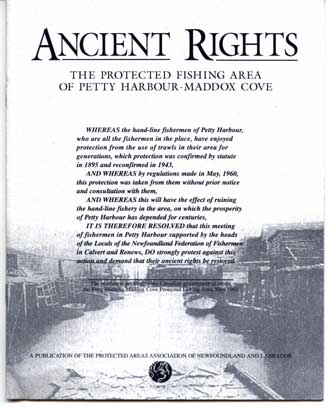
WHEREAS the hand-line fishermen of Petty Harbour, who are all the fishermen in the place, have enjoyed protection from the use of trawls in their area for generations, which protection was confirmed by statute in 1895 and reconfirmed in 1943,
AND WHEREAS by regulations made in May 1960, this protection was taken from them without prior notice and consultation with them,
AND WHEREAS this will have the effect of ruining the hand-line fishery in the area, on which the prosperity of Petty Harbour has depended for centuries,
IT IS THEREFORE RESOLVED that this meeting of fishermen in Patty Harbour supported by the heads of the Locals of the Newfoundland Federation of Fishermen in Calvert and Renews, DO strongly protest against this action and demand that their ancient rights be restored. (The resolution petitioning the Canadian government to create the Petty harbour-Maddox Cove Protected Fishing Area, May 1961).
People were adamant that centuries of positive and productive experience with hand-lining should not be thrown away due to a misguided decision by Ottawa bureaucrats. The federal government somewhat reluctantly took on the work of formerly drafting the regulation to protect the area as per the wishes of a clear majority of local people.
The establishment of the Protected Fishing Area had significant benefits for the community. In addition to the fact that it reversed a decision that had eliminated their community's historic rights, the new regulations ensured that the Protected Fishing Area did not become inundated with ghost nets--lost gill nets that continue to fish unattended. In addition, whether anticipated or not, the decision had tremendous conservation value for the fishing grounds as many people believe that the hand-lining practice actually enhanced the area's cod stock. Finally, the decision had tremendous positive impacts on the local community--it ensured a higher level of employment than would have been the case with the other gear types; it ensured that younger fishers could enter the fishery, something that was unlikely with the newer gear types (the number of new fishers allowed entry into these fisheries was tightly controlled); it ensured higher than average, and high quality, fish landings; and perhaps most importantly, it contributed to the community's sense of pride and sense of control over its own affairs.
Generally speaking the Protected Fishing Area regulation remained intact and had broad community support, with the exception of a several disagreements relating to the outer limits of the protected zone with St. John's and Bay Bulls fishers, until the Northern Cod Moratorium of 1992. With the collapse of the Northern Cod stocks and the resulting destruction of livelihood for over 30,000 fishers and plant workers across the province, communities like Petty Harbour-Maddox Cove were thrown into chaos. After the moratorium was declared, deep divisions were opened in the community especially due to the way the moratorium and its compensation programs were being administered. Not only were people forced to make a living by any means possible, they were being slowly and gradually removed from the fishery through a staggered system of compensation cutoffs and buyouts. In this context it appeared that the importance of conservation and long-term resource planning, at least in the minds of some community fishers, was about to be forgotten or downplayed in local fisheries decisions.
In May 1996, local fishers desperate for an income, voted by a narrow majority to allow lumpfish gill nets into the Protected Fishing Area. This marked the first time groundfish gill nets were ever allowed inside the area.
The community and the fishers were divided. The status of the Protected Fishing Area was now compromised. The community faced serious questions about the need for the Protected Fishing Area and about the overall vision of the fisheries of the future. Some felt the Protected Fishing Area was at the edge of a slippery slope.
At this time two concerned individuals, Bernard Martin, a well-known local fisher from Petty Harbour, and Shelley Bryant, a local environmentalist, were travelling the province as part of a Protected Areas Association, Marine Protected Area awareness tour. While facilitating local meetings in other rural communities where the merits of Marine Protected Areas were being debated, the Petty Harbour Protected Fishing Area was raised frequently as an example of a successful "limited" Marine Protected Area. The Petty Harbour example was often raised by local people who knew little about it except that it seemed to work for the people of Petty Harbour and that it was worth consideration.
The facilitators realized how a document outlining the Petty Harbour experience could be useful for fishing communities across the province concerned about marine conservation. They also could not avoid the irony in the interest in the Petty Harbour example, as the Protected Fishery Area constantly raised as a success story across the province, appeared to be under siege by the very people who had created it in the first place.